

Product Overview
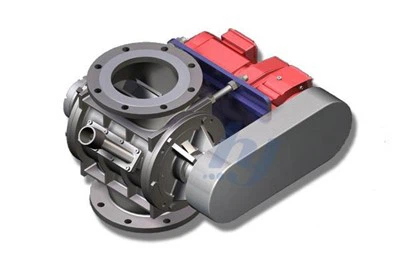
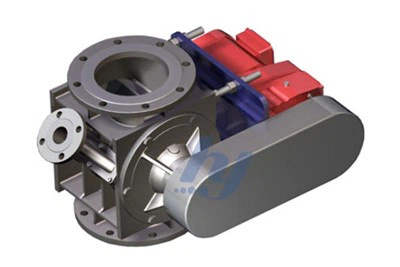
A rotary airlock valve is engineered to discharge bulk powders, granules, and pellets from silos, hoppers, cyclones, and dust collectors while maintaining a stable differential pressure seal between connected process equipment.
The valve utilizes a multi-vane rotor rotating within a precision-machined housing to transfer metered volumes of material continuously. Tolerances between the rotor and internal housing bore, combined with the selected shaft sealing arrangement, govern air leakage control, volumetric efficiency, and suitability for specific material characteristics and pressure profiles.
Rotary airlock valves are deployed across pneumatic conveying systems and gravity discharge lines. Equipment selection is determined by material bulk density, particle size distribution, abrasiveness, required throughput, operating temperature, and system pressure differentials.
For preliminary model sizing, please provide the material type, bulk density, required capacity, inlet and outlet flange dimensions, operating temperature, and system pressure or vacuum conditions.
-
![Fall-Through Rotary Airlock Valve]() Fall-Through Rotary Airlock ValveThe Fall-Through Rotary Airlock Valve (standard carbon steel/stainless steel construction, custom options available for wear-resistant/non-stick/high-temperature resistant applications) is a...view more
-
![Blow-Through Rotary Airlock Valve]() Blow-Through Rotary Airlock ValveThe Blow-Through Rotary Airlock Valve is a high-efficiency feeding and unloading device specifically designed for direct-blowing powder conveying applications.view more
-
![Quick-Clean Rotary Airlock Valve]() Quick-Clean Rotary Airlock ValveThe Hanyue Quick-Clean Rotary Airlock Valve is a high-efficiency integrated feeding, unloading, and cleaning device tailored for high hygiene requirements and multi-material switching conditions....view more
-
![Sanitary Rotary Airlock Valve]() Sanitary Rotary Airlock ValveThe Sanitary Rotary Airlock Valve is a core feeding and unloading device specifically designed for industries with stringent requirements for cleanliness and sterility, such as food,...view more
-
![De-Duster Rotary Airlock Valve]() De-Duster Rotary Airlock ValveThe De-Duster Rotary Airlock Valve (also known as a star-shaped ash discharge valve or airlock ash discharge valve) is an indispensable core airlock and ash discharge accessory in industrial dust...view more
-
![High Pressure Rotary Airlock Valve]() High Pressure Rotary Airlock ValveThe High Pressure Rotary Airlock Valve is a core feeding and airlock device specifically designed for high-pressure pneumatic conveying systems. Leveraging the company's years of experience in...view more


Controlled Volumetric Discharge
Internal rotor pockets receive bulk material by gravity from upstream equipment and transport it continuously to the discharge flange, ensuring steady material feed rates under proper operational parameters.
Precision Rotor and Housing Clearances
Radial and axial clearances between rotor tips and the housing bore are maintained within strict engineering tolerances—typically between 0.08 mm and 0.15 mm depending on valve size—to minimize air blow-back and optimize volumetric efficiency.
Engineered Shaft Sealing Arrangements
Shaft sealing options are tailored to specific media and operating environments. Available configurations include adjustable multi-ring packing glands or gas-purged shaft seals designed to isolate bearing assemblies and prevent fine particulate migration.
Material of Construction Flexibility
Housing and rotor metallurgy can be specified according to material abrasiveness, chemical compatibility, operating temperature, and cleanliness requirements. Standard construction options include GG25 cast iron, GGG40 ductile iron, and AISI 304 or AISI 316L stainless steel.
Robust Drive and Mechanical Integration
Drive configurations, including direct-coupled gear motors or chain and sprocket assemblies equipped with safety guards, are matched to system layout, required rotational speed, and torque demands.
Working Principle
The rotary airlock valve operates through a multi-vane rotor turning inside a stationary, close-tolerance cylindrical housing.
Inlet Loading
Bulk material flows by gravity from the upper storage vessel, cyclone, or dust collector hopper into the top open pockets of the rotor.
Material Transfer
As the shaft rotates, the internal pockets convey the material through a 180-degree housing arc from the inlet flange toward the discharge opening.
Discharge Phase
At the bottom flange, material falls freely by gravity into the downstream pneumatic conveying line or collection vessel, while the empty pocket rotates back upward.
Pressure Sealing Barrier
A minimum of two rotor blades maintain continuous sealing contact with the internal housing bore at all times, establishing a functional barrier that limits compressed air or vacuum bypassing upward into the feed hopper.
Pneumatic Conveying Systems
Utilized at material feed and discharge points in positive-pressure and vacuum dilute-phase or dense-phase conveying lines. Valve selection must account for line pressure, acceptable air leakage, and required mass feed rates.
Dust Collection Systems
Installed beneath baghouses, cartridge dust collectors, cyclones, and air filtration hoppers to continuously discharge collected fly ash, cement dust, or industrial particulate into downstream material handling systems.
Powder and Granular Bulk Handling
Suited for free-flowing powders, pellets, and dry granular solids. Cohesive, fibrous, fragile, or highly abrasive materials require specialized rotor geometries (such as bevel-edged or closed-end designs) and hardened internal housings.
Chemical and Mineral Processing
Material and sealing configurations can be specified for abrasive or corrosive mineral powders and chemical compounds (e.g., titanium dioxide, carbon black, and plastic resins). Compatibility must be evaluated against specific material chemistry and environmental conditions.
Food and Pharmaceutical Processing
Applications requiring sanitary standards and cleanability utilize stainless steel construction, polished internal surfaces (such as Ra < 0.8 um), and food-grade sealing components. Material traceability and hygienic design parameters apply only when explicitly configured and documented for the order.

Technical Specifications
The following table outlines standard industrial specification ranges for rotary airlock valves.
|
Parameter |
Standard Specification Range |
|
Valve Sizes (Inlet/Outlet) |
DN100 to DN600 (4 inches to 24 inches) |
|
Housing Materials |
GG25 Cast Iron, GGG40 Ductile Iron, AISI 304, AISI 316L Stainless Steel |
|
Rotor Configurations |
Open-end, Closed-end, Adjustable-tip blade, Pocket-reduced |
|
Max Pressure Differential |
Up to 1.5 bar (Standard Duty) / 2.5 bar (Heavy-Duty Reinforced) |
|
Operating Temperature |
Standard: -20 C to +80 C / High Temperature: Up to +250 C |
|
Drive Arrangement |
Direct-coupled gear motor or chain/sprocket drive with safety guard |
|
Surface Finish |
Ra < 0.8 um (Internal polished for sanitary grades); Industrial primer and epoxy coating externally |
|
Shaft Sealing |
Adjustable packing glands, air-purged shaft seals, or lip seals |
|
Connections |
Flanged connections matching standard international drilling patterns |
Customization and Manufacturing Quality
Application-Based Configuration
Valves can be configured to address specific operational constraints, including abrasive wear, corrosion risks, temperature extremes, pressure differentials, and sanitary standards. Potential engineering options include:
Wear-Resistant Surface Treatments: Hard-chrome plating, tungsten carbide thermal spraying, or Stellite weld-overlay on rotor tips and housing interiors for abrasive mineral applications.
High-Temperature Execution: Extended shaft bosses and air-cooling jackets for continuous processes exceeding 150 C.
Sanitary Execution: FDA-compliant food-grade elastomers, quick-dismantling rotor designs for routine washdown, and mirror-polished internal product-contact surfaces.
Manufacturing and Quality Control
CNC Machining Operations: Housing bores and end plates are machined on high-precision CNC boring mills to ensure strict concentricity, exact alignment, and controlled running clearances.
Material Traceability: Material Test Reports (MTRs conforming to EN 10204 3.1) can be supplied for pressure-containing metal components upon specific project request.
Factory Inspection: Routine dimensional verification, mechanical assembly checks, and factory leakage testing are performed prior to dispatch in accordance with established manufacturing standards.
Related Products and Spare Parts
Rotary airlock valves operate within integrated material handling networks. Associated equipment and replacement parts include
Dust Collection Equipment
Bag filter units, cartridge collectors, and associated filtration hoppers.
01
Pneumatic Conveying Components
Conveying lines, blow-through adapters, and material feed manifolds.
02
Replacement Rotors
Factory-balanced replacement rotor assemblies matched to exact valve serial specifications.
03
Shaft Sealing Kits
Replacement packing rings, seal elements, and gland follower assemblies.
04
Drive Assemblies
Compatible gear reducers and motor units, subject to model availability.
05
Frequently Asked Questions
As one of the most experienced rotary airlock valve for powder manufacturers and suppliers in China, we offer a wide range of products with superior quality. We warmly welcome you to buy customized rotary airlock valve for powder at competitive price from our factory. For more information, contact us now.
High Pressure Rotary Airlock Valve, Sanitary Rotary Airlock Valve, Fall Through Rotary Airlock Valve