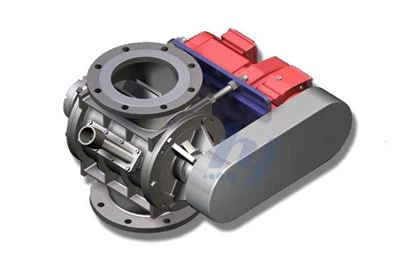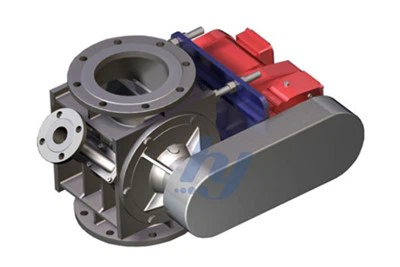

If you have ever sourced rotary airlock valves, you have likely encountered a puzzling issue: why do seemingly identical products vary so widely in price? Some suppliers quote a few hundred US dollars, while others charge several times that amount. Even valves of the same size and bore diameter can have drastically different price points.
Many first-time buyers assume, "It's just a discharge valve, after all." However, once the project is underway, they quickly realize that a rotary airlock valve is far from a simple standard component. Varying operating conditions, powder materials, and system pressures demand vastly different structural designs and manufacturing specifications-and these differences directly translate into cost disparities.
In this guide, we will systematically analyze the cost components of rotary discharge valves from the perspectives of construction, materials, craftsmanship, performance requirements, and industry standards. This will help procurement professionals, engineering firms, and system integrators accurately budget and evaluate supplier quotes.
Why Do Rotary Airlock Valves Vary So Widely in Price?
Most new buyers mistakenly treat rotary airlock valves as standardized products. In reality, they are typical semi-custom industrial equipment.
Low-cost valves do not necessarily fail to operate, but they commonly develop chronic issues over time:
- Air leakage after a few months of operation
- Frequent bearing failures
- Rotor jamming
- Severe dust leakage
- Declining conveying efficiency
- Escalating long-term maintenance costs
For continuous production lines, the true cost is not the equipment itself, but downtime.
In industries such as cement, chemicals, and food processing, a single shutdown can result in losses far exceeding the valve's purchase price.
Therefore, the price of a rotary airlock valve represents more than just the equipment-it represents:
- Operational stability
- Sealing performance
- Service life
- Long-term maintenance costs
- Reliability under continuous operation

Key Factors Affecting Rotary Airlock Valve Pricing
1. Body Material
Material selection is one of the most direct drivers of cost.
(1) Carbon Steel
The most common and economical option, widely used in general industrial applications, including:
- Cement
- Fly ash
- Construction powders
- Standard dust collection systems
Carbon steel meets the requirements for these applications, offering low cost, mature processing, and short lead times. However, it has limited corrosion resistance and is unsuitable for humid, highly corrosive, or food-grade environments-most low-cost valves use standard carbon steel construction.
(2) Stainless Steel
Food, pharmaceutical, and chemical industries typically require SUS304 or SUS316 stainless steel, which commands a significant price premium over carbon steel.
Key reasons for higher cost:
- Higher raw material costs
- Stricter welding and polishing standards
- Rigorous sanitary compliance requirements
Food-grade specifications such as mirror polishing, dead-space-free design, and quick-disassembly construction add substantial manufacturing complexity, further increasing costs. European and American clients often enforce stringent surface finish and sanitary design standards.
(3) Wear-Resistant Materials
Highly abrasive materials require specialized construction, significantly raising costs. Typical materials include:
- Quartz powder
- Mineral powder
- Metal powder
- Cement clinker
Standard steel valves may wear through in months when handling these materials. Solutions include:
- Wear-resistant liners
- Surface hardening
- Ceramic linings
- Wear-resistant rotors
While these upgrades increase upfront cost, ignoring wear resistance leads to far higher long-term repair expenses. Experienced buyers recognize that the most economical choice is rarely the cheapest upfront, but the most durable over time.
2. Valve Size
Larger valves typically cost more-not only due to increased material usage but also because:
- Rotor machining complexity rises
- Higher precision dynamic balancing is required
- Greater drive torque is needed
- Heavier-duty bearings are required
- More complex sealing structures are necessary
For example, a 6-inch valve can cost several times less than a 16-inch model. Large-bore valves with insufficient rotor precision risk jamming, air leakage, abnormal bearing wear, and excessive vibration.
3. Rotor Design
Rotor configuration significantly impacts pricing. Common designs include:
- Open rotors
- Closed rotors
- Anti-stick rotors
- Adjustable rotors
- Wear-resistant rotors
- Low-breakage rotors
Specialized designs increase manufacturing complexity: low-breakage rotors for fragile food products like coffee beans, or modified blade clearances for high-temperature dust systems.
4. Airtightness Requirements
A core function of rotary airlock valves is maintaining differential pressure. Higher airtightness standards equate to higher costs.
Economy valves typically feature:
- Excessive clearances
- High leakage rates
- Low machining precision
Premium valves incorporate:
- Precision-machined rotors
- Minimal blade-to-housing clearances
- Multi-stage sealing systems
- Air-purge seals
- Labyrinth seals
Stringent airtightness requirements are critical for positive-pressure pneumatic conveying, high-vacuum systems, and fine powder handling-directly increasing manufacturing costs.
Industry-Specific Pricing Logic
1. Food Industry
Primary priorities: cleanliness, hygiene, contamination prevention.
- Full stainless steel construction
- Mirror polishing
- Quick-disassembly design
- FDA-compliant seals
Prices are consistently premium, reflecting strict industry standards.
2. Cement & Mining Industries
Primary priorities: wear resistance, heavy-duty operation, long-term stability. Aesthetics are secondary-durability and robustness are paramount.
3. Chemical Industry
Primary priorities: corrosion resistance, explosion protection, superior sealing. Strict safety standards apply, especially for volatile or hazardous dust applications.
Explosion Protection Requirements: A Major Cost Driver
Applications involving the following materials typically require ATEX compliance:
- Flour, sugar powder
- Wood dust
- Chemical dust
- Metal dust
Compliant valves require:
- Explosion-proof motors
- Conductive design
- Anti-static construction
- Explosion-proof certification
Certification itself adds substantial costs. First-time European/American project buyers often underestimate this expense.
Hidden Costs of Low-Priced Valves
A common industry pitfall: buyers select solely based on upfront price, only to face chronic failures after six months of operation:
- Repeated bearing failures
- Severe material leakage
- Premature rotor wear
- Unstable system pressure
- Dust emissions
Long-term maintenance costs quickly exceed initial savings. For continuous production lines, unreliability is far costlier than a higher purchase price.
Key Considerations for Procurement
Professional buyers do not simply ask, "What is the price?" They verify critical operating parameters:
- Material type being handled
- Operating temperature
- Abrasiveness level
- Explosion protection requirements
- Food-grade compliance
- System pressure
- Continuous vs. intermittent operation
- Airtightness specifications
These parameters define the valve's design. Price discrepancies between suppliers rarely stem from arbitrary markup-they reflect fundamentally different specification levels.
Critical Insight: Total Cost of Ownership
Mature international buyers prioritize total cost of ownership (TCO) over purchase price, considering:
- Service life
- Maintenance frequency
- Downtime risk
- Energy consumption
- Replacement part costs
Over the long term, reliable equipment delivers superior cost efficiency. This is why major manufacturers maintain long-term partnerships with trusted suppliers.
Conclusion
The price of a rotary airlock valve is never merely a reflection of its physical components.
True cost drivers include:
- Operating condition complexity
- Manufacturing precision
- Sealing performance
- Material grade
- Long-term operational reliability
Sourcing the cheapest valve is simple. The challenge lies in selecting a solution that matches operating conditions, minimizes failures, and ensures long-term stability.
Low prices only save money on the day of purchase. Real costs emerge over the valve's operational lifespan.
If you are seeking a rotary airlock valve for pneumatic conveying, dust collection, or powder processing systems, contact Hanye with your specific operating requirements.
We offer standard industrial, high-airtight, wear-resistant, food-grade, and explosion-proof configurations. Our team recommends optimized solutions tailored to material characteristics, conveying pressure, temperature, and site conditions-not just generic quotes.
Provide material type, conveying method, temperature/pressure parameters, throughput, and installation dimensions, and we will assist with initial selection and design recommendations.